- Continue Shopping
- Your cart is empty

Our spring shipment from France is ready for viewing!
Our latest arrivals from France are all about spring! We love to garden, and this shipment shows it--stone columns from a French manor house garden, a nineteenth century stone garden fountain, aged stone planters and urns, garden benches, and a magnificent statue of Saint Michael the Archangel fighting the dragon and giving his blessing.


Our doors have re-opened with our latest treasures. We will have our first sampling online soon, but in the meantime, come see what's new (or rather, old) at French Metro and pause in our tulip garden blazing in glory with 2000 tulips in bloom!

Amassing My Own Armies

Louis XIV loved the dance, Louis XVI loved locks, and Napoleon was passionate about mathematics. Hobbies are essential to all people. They add character and make people interesting. Though my hobbies are numerous, there is one that stands out more than the rest. It all started when I was still just a teenager. On her return from yet another buying trip in France, my mother presented me with a small gift: a gift that would develop into a strong passion. What she gave me was a variety of lead soldier molds and casting metal. In the beginning, it was a collaborative effort on the part of my father and me. We casted a dozen or so together, and then he would paint them. However, as time went on, I gradually took over the operation.
Overall, the process takes about a day per soldier. First, I must powder the molds so the metal will cool faster.

Then I melt the metal and pour it into the mold.


Sometimes this takes multiple attempts until I get a good cast. Next I cut off the excess and file down my soldier.


Once complete, I paint the parts and glue the soldier together. This part of the process is an all-day affair, requiring patience as I wait for paint to dry.

It wasn’t until I was sixteen that I fully launched myself into mass production. That summer proved very productive. I probably casted a good forty or so soldiers. To top it all, I spent that summer making a 50” by 50” diorama. I laid out my plan topographically, making two hills and a road down the middle with trees from model train sets scattered around. I added a stone well, and constructed a scale model of a house out of wood, going as far as to make shingles out of cut-up popsicle sticks. As a hobby, it was a gradual affair. At first, all I was doing was casting Napoleon’s Imperial Guard. My options were limited then. Eventually I attained more molds; Napoleon on horseback, canons and crew, and sappers.

After I amassed a good number of troops, I realized that my French army had no enemy, and that their battle-ready positions on my diorama looked rather silly. Therefore, I obtained molds for the British foot soldiers.

Hobbies develop slowly, and there were times when I had to sell a few soldiers in order to afford supplies for more. Over the years, I have acquired books on Napoleonic uniforms and have become very detail oriented, going as far as to paint insignias and cocardes on my soldier’s uniforms. My most recent endeavors include making French line infantry, skirmishers, and developing a new diorama (I had to throw away the old one since it was too cumbersome and hard to transport from residence to residence). I’ve been asked before what I plan to do with them, or when I will reach a stopping point. I have no intention of stopping any time soon. Hobbies are meant to be fun, and quitting is never fun. I’m not sure what new facets I will delve into, but I’m sure that I’ll finish my next diorama and then expand even more. Who knows, maybe cavalry is in my future. In any case, my passion for French history has fueled some very large armies!

Commemorating la Fête de la Victoire May 8th 1945 or Victory in Europe Day

On May 8th, 1945, church bells rang throughout Paris, ushering in a new age of peace in Europe. Charles de Gaulle, the leader of the Free French Forces, announced an official declaration over the radio, announcing an end to the conflict we recognize as World War II and marking the conclusion of a six-year war and the Nazi oppression in France. Having been the symbolic leader of the Resistance in France during the German Occupation, de Gaulle addressed his countrymen and their allies with a moving speech that reached the very core of French hearts.

“The war is won. This is victory. It is the victory of the United Nations and of France. The German enemy has just capitulated before the Allied armies of the West and the East. The French Command was present and took part during the act of capitulation…
While the rays of glory shine once more on our resplendent flag, the nation expresses its thoughts and love, first, toward those who died for her, then toward those, who in her service fought and suffered so much for her. Not one effort of these soldiers, of these sailors, of these aviators, not one act of courage or selflessness of her sons and of her daughters, not one suffering of these men and women prisoners, not one mourning, not one sacrifice, not one tear will have thus been lost in vain. In joy and national pride, the French people address their fraternal salute to their valiant allies, who, like themselves, and for the same cause, have long and painfully languished in sorrow. To their heroic armies and to the leaders who command them, to all these men and to all these women, who in the entire world, have fought, suffered, worked, so that in the end of ends, justice and liberty would be theirs. Honor! Honor for all our armies and their leaders, honor to our people whose terrible trials have neither reduced nor weakened them, honor to the United Nations who have joined their blood to our blood, their sorrows to our sorrows, their hope to our hope, and who today triumph with us. ….Long live France!”
Victory over the Axis powers was celebrated worldwide in every major city, but nowhere was it more welcoming than in Paris. A sensitive subject for most of the French who endured this era of resisted subjugation, my introduction to this period in history was through my host grandmother, Genevieve Guy, who is now ninety-nine years old.

Genevieve remembered life under the puppet government of Vichy in southern France and would tell me about it whenever it was just the two of us at the chateau that her family has lived in for generations. After school, I would often sit and talk with her about her experiences. Ration cards, curfews, using car tires for shoes, and even executions in her town englobed her experiences during the Nazi occupation. Most of her stories she told to me while we were watching a documentary on World War II together. Having formed a very close bond with me, she imparted how she and others dealt with events at the time. She told me about the opposing viewpoints of de Gaulle and of Pétain, the president of Vichy, France, and about the shame of the collaborators and their punishment after the Allied Victory. I also learned about Jean Moulin, the Resistance leader in southern France, who was a native of Béziers where I was living. Most of all, she talked about her father, a former soldier of the First World War. At the outbreak of World War II, he was then a doctor in Montpellier, in the Languedoc region of France. His feeling was one of disgust with the war due to his disappointment in how the First World War had accomplished so little. Nevertheless, the end of World War II meant more than simply reinstituting national pride in people like her father. It also meant that she herself no longer had to watch idly as a generation of men and women coped with having been vanquished. The 8th of May represented something momentous to her. It was a revitalization of the French communal spirit. The reunifying effect after Victory in Europe Day was an assurance that the soul of France was still intact. Therefore, this day, like that of seventy-two years ago, we must acknowledge the rebellious spirit of the millions of men and women who endured so much. Their tears were not in vain. May they never be forgotten.

From Garden to Table in France…

This past summer, I met the parents of my French girlfriend, Pauline. Residing in the small village of Mazangé, near the town of Vendôme (a two hour drive from Paris), they live in an old house that boasts a garden, orchard, chicken and duck coop, as well as a rabbit hutch. When we arrived at their home, the gates opened up to this vast garden and patio space.
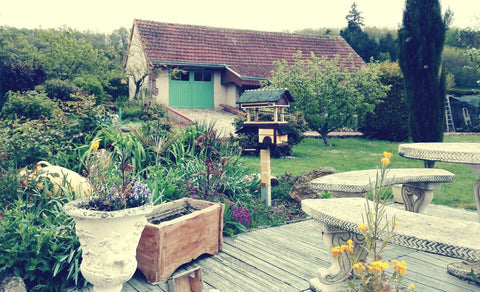
There was a practical kitchen garden as well as flowers and plants of all varieties.

I was greeted by her father Dany who was in the middle of tinkering with an old French car. He runs the operations of the village and its upkeep. A former welder, he and Pauline’s mother, Maryline, were very into motorcycles and had even taken a road trip down Route 66 a few years before. Upon my arrival, we moved to an outdoor table, and had a small aperitif of a rose thorn alcohol that Dany had made. Once her mother came home, we drove to the grocery store so as to collect things for that evening’s dinner. I had been bold enough to offer my culinary skills for the evening since I’d spent the last year working with my brother Elliot, the chef at Theo’s in Fayetteville. However, I hadn’t imagined how hard on my nerves it would prove to be. For one thing, I knew I wanted to prepare fish since it was summertime, and Pauline had told me that her family tends to eat light meals. However, when we arrived at the fish market, I recognized only a few of the fish there. As I stood there undecided, I began to wonder if I could even pull it off. Finally, after much discussion about which fish were similar to those that I knew, Maryline (who had accompanied us) and I decided upon a fish together. I had never heard of it before, and still to this day cannot recall the name. It looked similar to turbot though, a thin white flaky fish that takes only a few minutes to cook. It was either going to make me or break me in the eyes of her parents (or so I thought). We arrived back at the house, and I immediately took control of the kitchen and began frantically trying to get myself together. Meanwhile, Pauline’s parents and sister did some gardening and Pauline picked radishes and arugula for my anticipated dish.
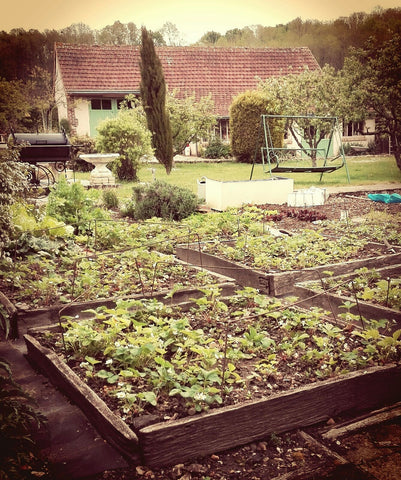
Pauline tried reassuring me that whatever I was going to do would be fine, but I was losing my mind at this point. My nerves were shot, and the pressure was on in my mind. I wanted to make a great first impression of myself to her family. After sautéing and mounting a medley of carrots, zucchini, and radishes in butter, I made an arugula pesto out of the arugula from the garden. Then came the most frightening part…the fish! I took a few deep breathes and reassured myself that I had done this enough times and in even more stressful circumstances. I told Pauline to gather everyone at the table and that I’d be only a few minutes more. I began with what I knew and seasoned the fish on both sides. I got my pan hot with oil in it and began laying the fish down. At first I wasn’t sure, but soon enough I realized that it was all going to work out just fine. I seared my fish off and began to plate: arugula pesto on the bottom, vegetables next, and the fish on top with a squeeze of lemon and a little more pesto. I then looked out of the kitchen window to see if all was ready, but my heart sank. No one was at the table! I rushed to Pauline and asked why nobody was gathered. She explained that this was normal and that it usually took a while before everyone finished up what they were doing. Though she persisted on how casual things were at her parent’s house, I spent the next few minutes painfully stressing about whether my food would stay hot. Finally, everyone gathered around the iron garden table, and we began eating. They were thrilled with the result, and to my relief, even hailed it worthy of a gastronomic restaurant. I’d done it! I’d succeeded in impressing the French with what culinary skills I had.

An Evening of Fine Antiques and Libations

Back in France...and the shopping begins!
New Shipment Arriving Soon!
Stay tuned for news about the arrival of our latest shipment from France! Arriving end of August!

An Evening with the Author, Talya Boerner

French Metro Antiques presents an Evening with the Author! Please join us on February 18th from 5-7 pm, for an evening with Talya Boerner. Talya, who resides in the Washington-Willow Historic District of Fayetteville, is proud to announce the release of her latest book, "The Accidental Salvation of Gracie Lee." Celebrate with us and partake of libations and fine hors d'oeuvres prepared by Chef Elliot Hunt.
Excerpt: The Accidental Salvation of Gracie Lee
"Last summer, Momma decided my little sister and I should learn to play the piano…Since I never planned to be in the Miss America pageant and wouldn’t need such a talent, I saw no point. What I really wanted to do was learn to speak French. I wanted to be that girl who, when invited to the White House for an important state dinner, would be the only person in the room who could speak with the French prime minister in his native language. I would help solve international problems while sipping champagne and wearing a black ball gown like Audrey Hepburn. President Nixon would be impressed to learn I started out as a farm girl from Arkansas. Last fall, I bought an old French lesson book at the library’s used book sale. Momma thought it was a silly waste. Besides English, Momma said the only practical language to learn was Spanish, because of our Mexican cotton choppers. Since I used my own money, she really didn’t have a say." ~The Accidental Salvation of Gracie Lee
By French Metro Antiques on 2012-06-06

Our Ship's Come In!
It's finally here! From the villages of France to Fayetteville...our latest container of French antique treasures is arriving this Friday, November 24th. So what does a 7:00 am Black Friday arrival mean? It wasn't quite in the plan, but our doors will be closed Friday while our crew works off a turkey stupor and unloads our latest 400 finds from France. We will re-open our doors on Friday, December 1st at 10:00 am. Hope to see you then!© 2026 French Metro Antiques. Powered by Shopify


